What Happened to Lloyd in Diepolder Sink #2?


| Incident location | Diver full name (deceased) |
|---|---|
| United States; Brooksville, Hernando County, Florida; Diepolder Sink #2 | Lloyd (surname not provided in source) |
On the night of May 11th, 1990, eight members of the Florida Speleological Researchers (FSR) prepared their diving gear for a challenging exploration at the Sand Hill Boy Scout Camp in Brooksville, Florida.
Formed in the late 1980s, the FSR consisted of cave divers dedicated to mapping uncharted systems. Among them that night was 25-year-old Lloyd, who brought with him his passion, his diving tanks, and his eagerness to push his skills further.
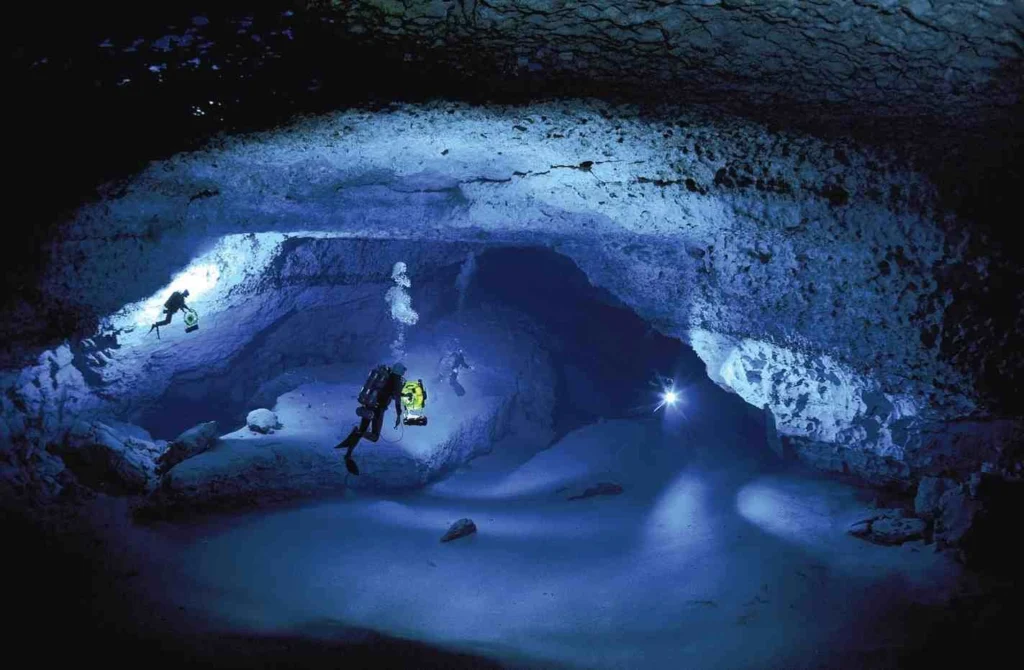
Their target was Diepolder Sink #2—an underwater cave notorious among elite divers.
FSR and the Diepolder Sink
Lloyd was particularly excited because nearly every dive, especially those involving advanced diving equipment like a diving computer or a new diving suit, fueled his enthusiasm for his newfound hobby.
However, this same eagerness had already earned him a reputation for pushing his limits. The Sand Hill Boy Scout Camp lies between Brooksville and Weeki Wachee Springs in Hernando County, Florida.
When the last member of the Diepolder family passed away in the 1970s, the once-private land became property of the Boy Scouts. Since then, its striking aqua-blue pond has fascinated some of cave diving’s most respected names.
A Cave of Global Interest
The Diepolder system consists of two regions—Diepolder Sink #2 and Diepolder Sink #3. Of these, #2 has become internationally known.
With a maximum depth of 360 feet (110 meters), it is the deepest known underwater cave in the continental United States.
Its tight entryway, remarkable chambers, and extreme depth have attracted legendary figures like Sheck Exley, who performed a 360-foot dive there in 1980 and helped define modern cave-diving practices.
The Dive Plan
Beginning the Descent
On May 11th, no one intended to reach the 360-foot mark.
Instead, the FSR planned a series of staggered two-person survey dives. Lloyd and his partner were the first group to enter.
Their plan was simple: complete a circuit route leading into an area known as the Ballroom, descending beyond 200 feet (61 meters).
For Lloyd, this dive held additional weight—it was his first time in this sink and an opportunity to set a personal depth record.
Equipped with their diving masks, diving tanks, and guidelines, the pair submerged and disappeared into Diepolder #2.
Through the Restriction
At the bottom of the main pool lay a narrow opening directing divers 180 feet (54 meters) straight down.
Beyond that drop, a bend led to the Junction Room. After navigating the tight entrance, the two divers encountered a serious obstacle: visibility had plummeted to zero.
Heavy rains in the region had churned silt inside the sink, clouding the water.
Fortunately, they had a guideline to follow—an essential tool in cave diving.
Progress Into Darkness
Reaching Clear Water
Passing through the Junction Room, the pair eventually reached clearer water along the upper circuit guideline.
A minor buoyancy problem briefly delayed one diver, but the issue was quickly corrected.
Continuing along the lower circuit guideline, they descended to 250 feet (76 meters), marking the deepest point of Lloyd’s young cave-diving career.
The First Signs of Trouble
At that depth, Lloyd suddenly released the lower guideline and began descending too quickly.
He lost the line entirely and appeared confused, swinging erratically into deeper water.
His partner pursued him, and both drifted into the massive Ballroom chamber. Here, in clearer water, they regained the guideline, and for a moment Lloyd seemed stable again.
Believing Lloyd was following the circuit toward the exit, his partner began his ascent.
Separation and Rising Concern
Decompression Stops
Due to their extreme depth, decompression stops were necessary.
During these pauses, Lloyd’s partner realized he could not see Lloyd—neither ahead nor behind.
Even after multiple stops, Lloyd never appeared.
At the 30-foot (9-meter) stop, concern sharpened into alarm.
Inside the basin of the entrance, the partner turned back to search but found nothing. After several minutes, he surfaced, hoping Lloyd had already exited. He had not.
The Search Begins
With visibility still low due to silt, it seemed possible Lloyd had passed unnoticed.
But the absence of any sign prompted an emergency response. While others called for help, Lloyd’s partner and another diver reentered Diepolder #2.
They reached the murky Junction Room but again found no trace of him.
They exited to wait for specialized recovery divers.
The Recovery
Finding Lloyd
Seventeen hours after Lloyd’s disappearance, the first recovery team entered Diepolder #2.
Within 25 minutes, they discovered his body beyond the Junction Room at a depth of 241 feet (73 meters).
He was head-down on the cave floor, only a few feet from the guideline.
Seven hours later, after navigating the tight entrance restriction, his remains were brought to the surface.
The Cause of Death
What Went Wrong
Investigators concluded that several factors contributed, but the primary cause was likely a combination of CO₂ buildup and nitrogen narcosis.
Losing the guideline in low-visibility conditions can trigger extreme fear even in seasoned divers.
For a relatively new cave diver like Lloyd, the panic was likely overwhelming.
Narcosis intensifies confusion and fear, increasing breathing rate and accelerating CO₂ buildup—eventually leading to blackout.
Recovery divers noted that Lloyd’s diving mask and regulator were still in place, suggesting he lost consciousness before sinking.
Final Moments
It is believed that Lloyd blacked out, descended to the floor of the cave, and ultimately drowned when his air supply ran out.
